
The Aurora Chase
A guided northern lights chase on each of the first four evenings of the week.
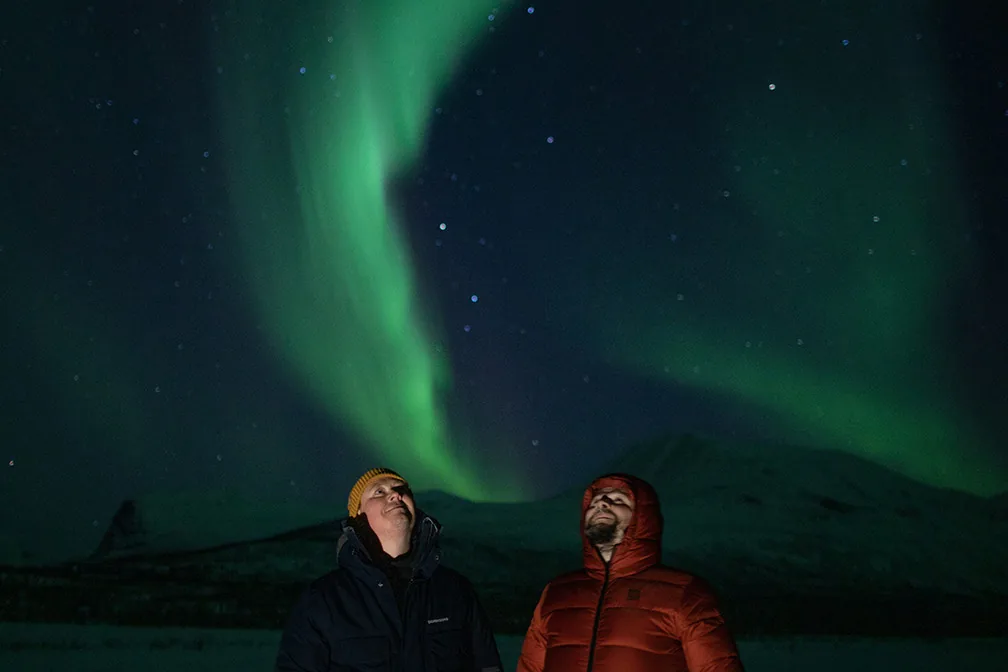
The first thing you notice is your own breath. You step out of the minibus, the door closes behind you, and the cold arrives in your nose before it reaches anywhere else - clean, dry, faintly metallic. Then the engine goes off and the silence lands. No traffic, no hum, nothing. Just snow absorbing every sound you make, and your boots squeaking on it like polystyrene.
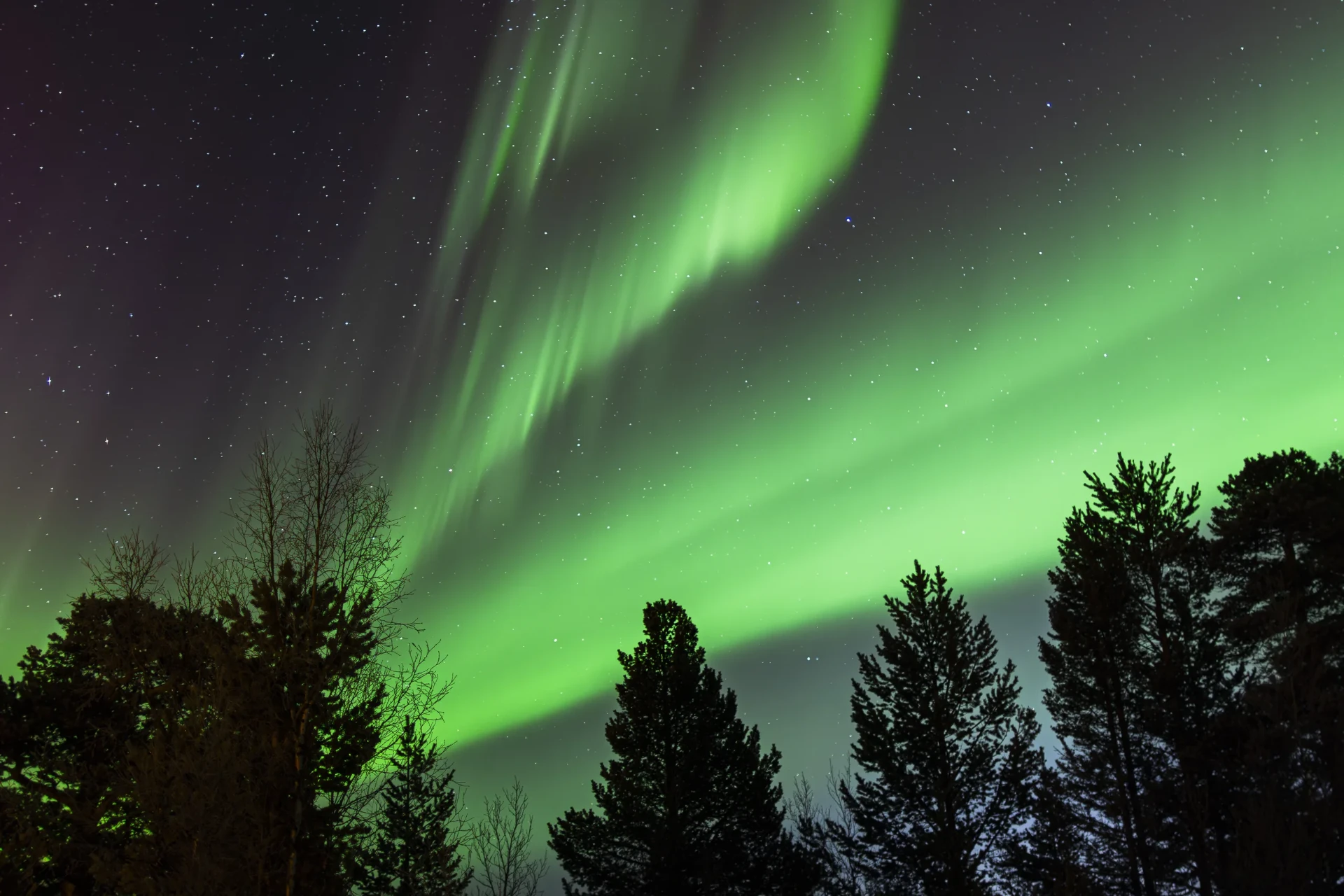
A clear night north of Kiruna, well away from the town lights.
Your eyes take about ten minutes to adjust. Stars come out in layers, more of them than you thought existed, and somewhere in among them there is a pale grey smudge that could be cloud. It is not cloud. It thickens, tips into green, and starts to move - slowly at first, then in long slow sweeps across half the sky, as if something is dragging light across it. Nobody speaks. Every group does the same thing: someone laughs, someone swears quietly, and then everyone just stands there with their head back until their neck aches.
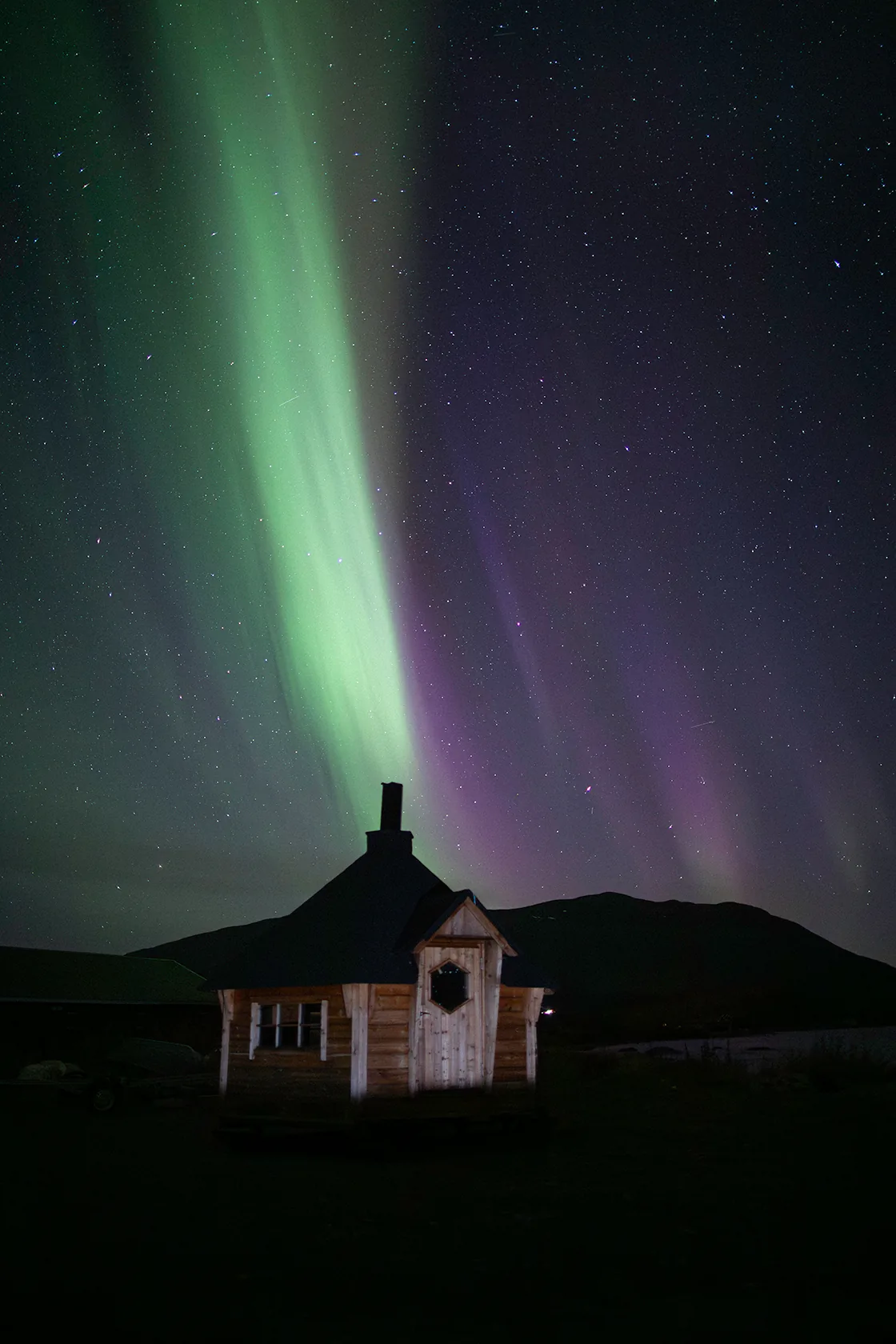
We wait with you
Nobody is counting minutes. If the sky is building we stay, and if the cloud rolls in we drive to where it is not. Hot drinks, a fire, and a guide who keeps reading the sky while you keep your eyes on it. That stubbornness is why, across five seasons, every group we have hosted has seen the northern lights, in varying strength.
Not every evening delivers. Some nights the cloud wins, you drink coffee by the fire and go home, and we say that up front rather than pretend otherwise. But you have four evenings, not one, and a guide who will drive an hour to find a gap - and across five seasons that combination has worked for every single group. People go quiet on the drive back, and message us months later to say they still think about it.
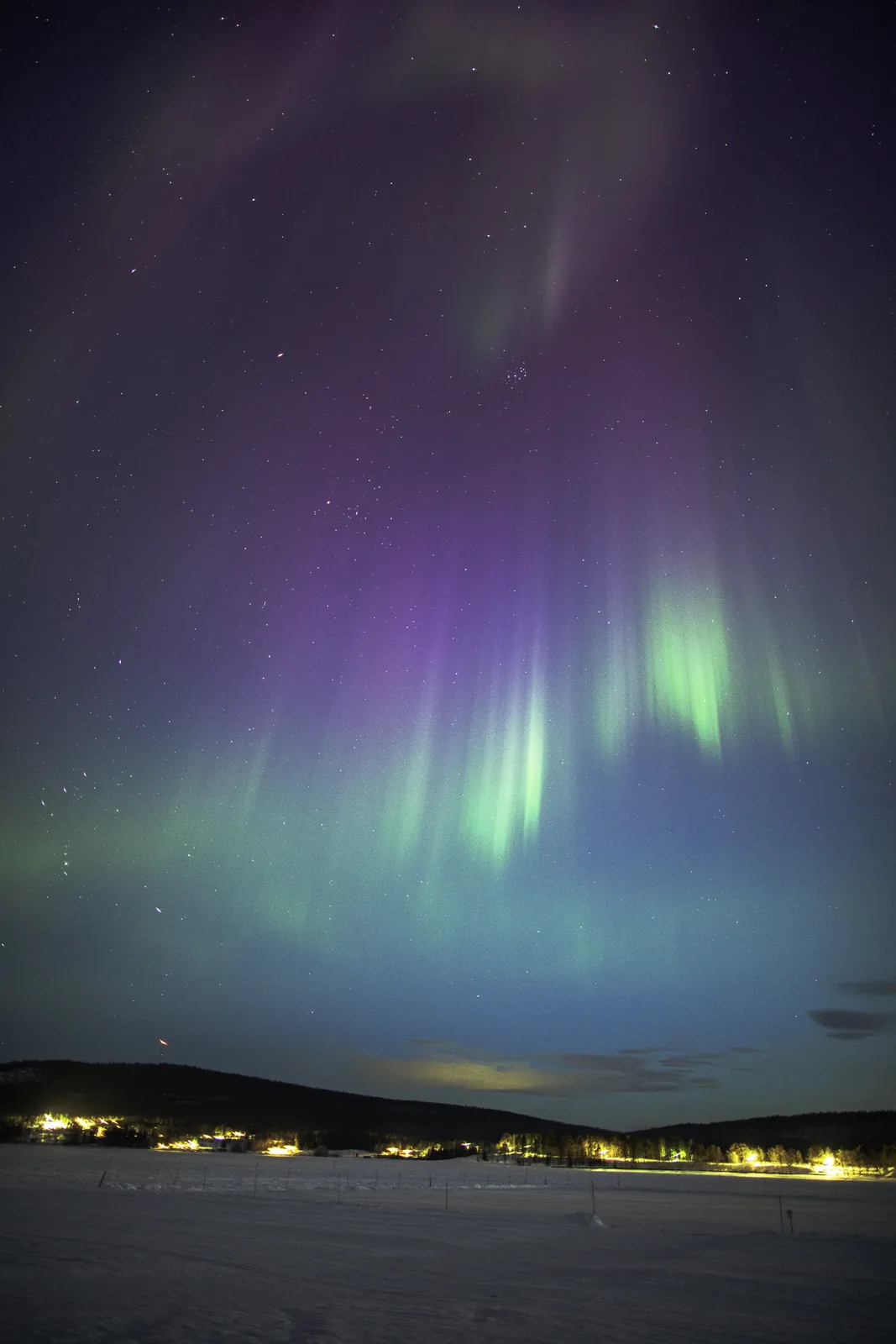
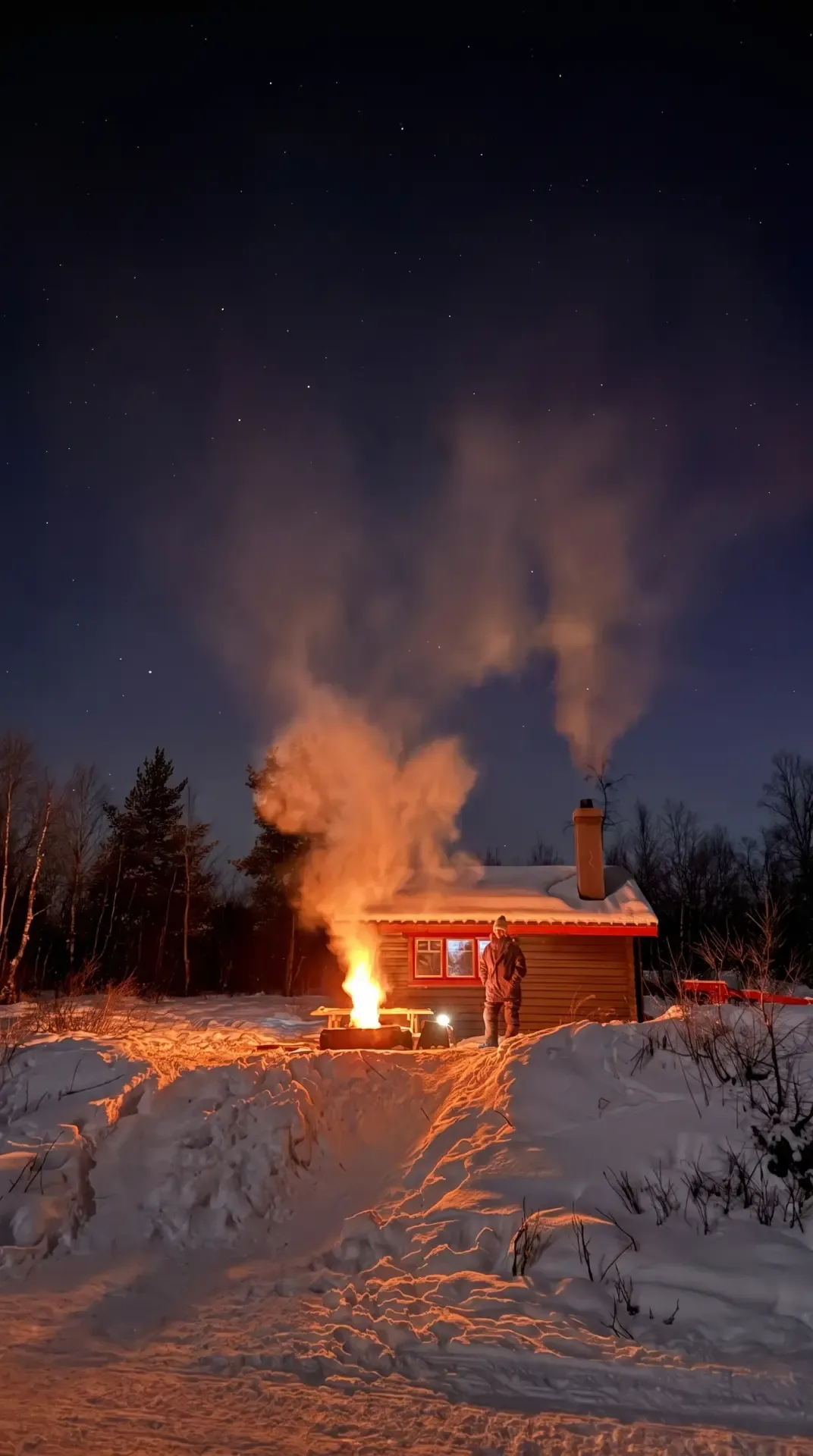
Aurora over the frozen lake, and a group that got the sky they came for.
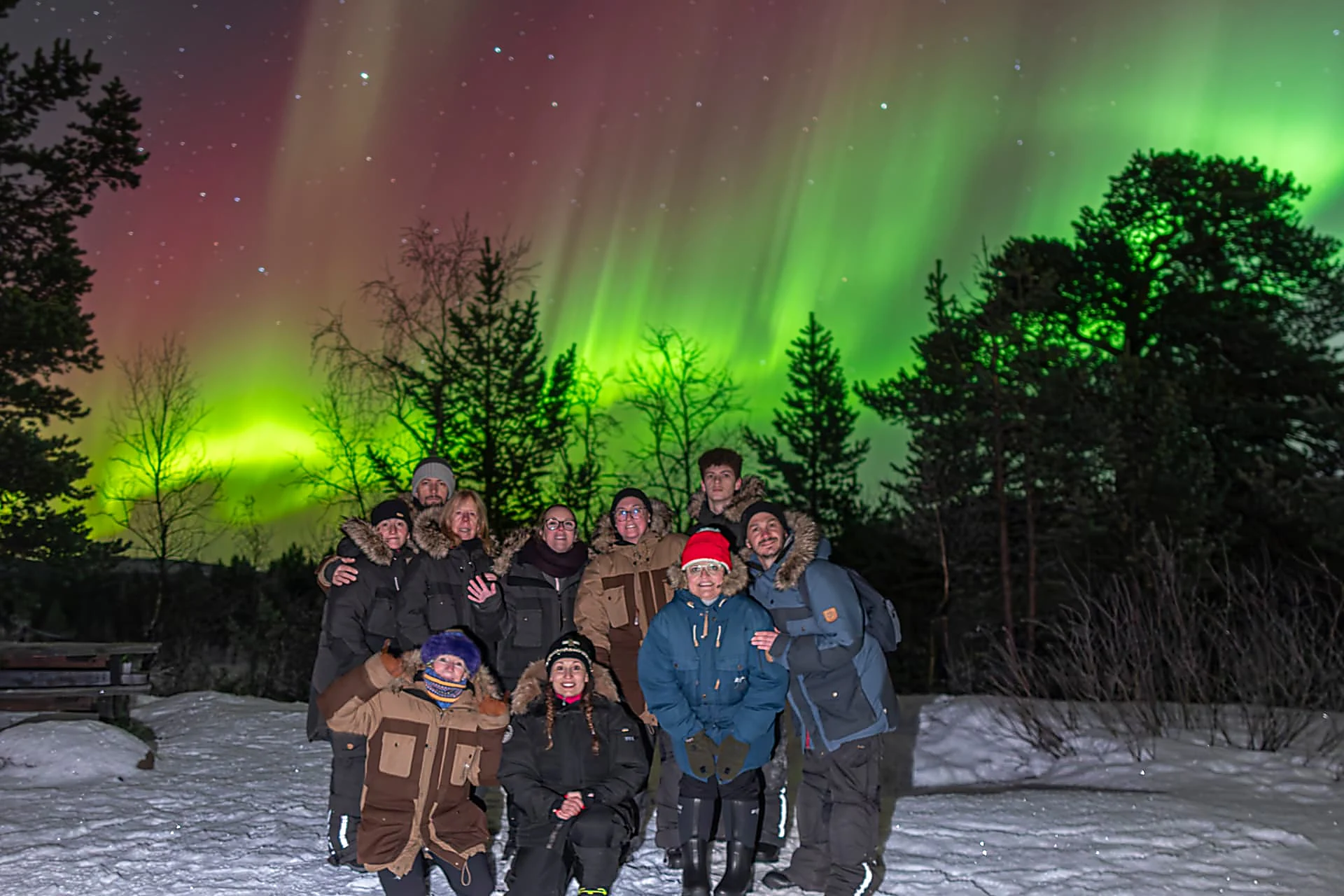
A full group under green and red aurora at the end of the night, out among the birch and spruce.
A different kind of aurora night
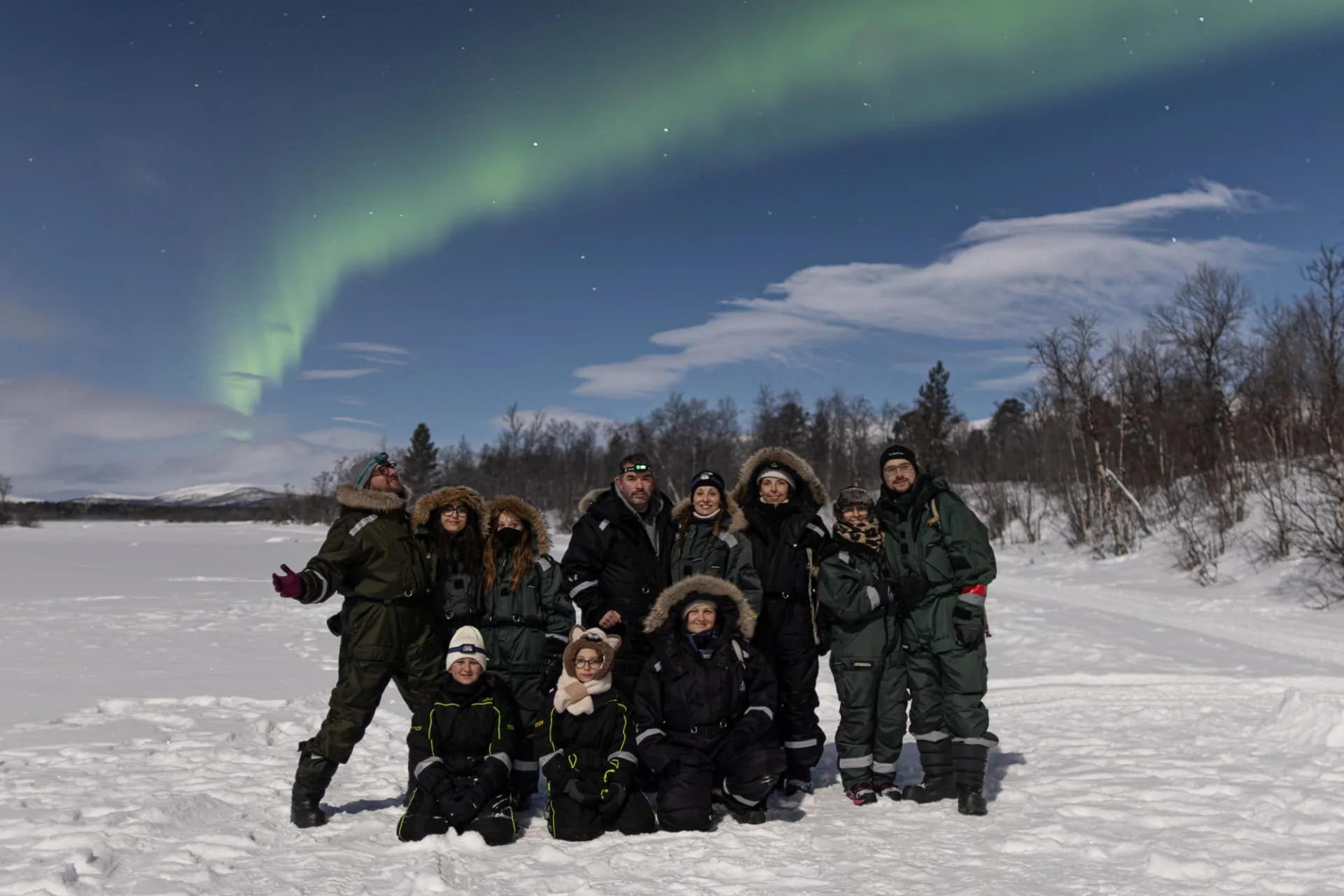
Some departure weeks fall on a full moon. That is not a compromise, it is a completely different night out. The snow throws the moonlight straight back, so the whole landscape glows - the fells, the pines, the frozen lake - and you can see exactly where you are putting your feet without a head torch.
The aurora is still clearly visible above it. What changes is the picture: instead of green ribbons floating in a black void, you get a lit landscape underneath them, which is why some of our favourite group photographs come from full moon nights.
Why our aurora chase is different
We do not run a fixed route on a fixed timetable. Every afternoon your guide reads the cloud maps, the KP forecast and the wind, and picks the departure time and the direction for that night specifically. If the sky is closed to the north we drive east. If it clears at eleven, we go at eleven.
Our guides live here and have spent hundreds of nights under this sky, and they go the extra mile - the extra hour of driving, the extra half hour of waiting - rather than call it early. Groups are small, so there is space for you at the fire and space to just be quiet if that is what you want. If you are cold, we go and warm up. If it is building, we stay. Nobody is herded back onto a bus because a schedule says so. We do not guarantee the sky. We guarantee four nights and guides who do not give up, and so far that has been enough every time.
A northern lights chase in Kiruna is less about luck than about knowing where to be. Our guides read the forecast, the cloud cover and the KP index each afternoon, then drive out - often well past the town's edge - to the clearest, darkest sky within reach.
This is one of the few places on earth where the aurora is a realistic possibility on any clear, calm winter night. We never promise the sky - nobody honestly can - but we are northern lights specialists who live here. What we do promise is four nights out and guides who keep driving until they find a hole in the cloud.
We go out on each of the first four evenings of the week, not once. That is the part most people underestimate: a single night out is a coin toss against the cloud, while four separate nights gives the sky four chances. Across five seasons, every group we have hosted has seen the northern lights, in varying strength - which is a record, not a guarantee.
Expect stillness. A single quiet evening with nothing but stars and coffee is not a failed trip when you have four of them, and it is often the night people describe most vividly afterwards.
- Four separate evenings out during the week, with departure from your accommodation after dinner and the time set that afternoon from the night's cloud and KP forecast
- A drive of twenty to sixty minutes to the clearest, darkest sky within reach, away from Kiruna's light pollution
- A lavvu with an open fire, or a fire outdoors, with hot drinks and fika so you can warm up whenever you need to
- A guide who reads the sky with you and explains what is happening as it happens
- Help with camera and phone settings, plus photos of your group taken by the guide
- Time - we stay while the sky is building rather than leaving on a fixed schedule
- Duration
- Approx. 3 to 4 hours per night, on four separate evenings
- Difficulty
- Easy - mostly seated and standing
- Season
- December to March
- Included in the Feel Good Week
The Aurora Chase in Kiruna - your questions answered
Kiruna sits directly under the auroral oval, which is the single biggest factor, and our season runs through the darkest months. Across five seasons, every single group we have taken out has seen the aurora during their week, in varying strength - one hundred per cent so far. Two things make that work: four consecutive nights out instead of one, and guides who know the region well enough to drive to a hole in the cloud. We still never promise the sky, because no honest operator can promise a natural phenomenon. What we promise is the four nights and the effort.
We drive. Cloud in Lapland is usually patchy rather than total, so your guide checks the satellite maps each afternoon and picks a direction with a hole in it, sometimes an hour or more from town. There have certainly been individual evenings where the sky stayed shut and we came home with nothing - that is not a failed trip when you have four of them, and so far the week has always delivered in the end.
It is a different aurora night rather than a worse one. The snow throws the moonlight straight back, so the whole landscape is bright, it is far easier to move around and see where you are putting your feet, and photographs get a foreground instead of a black void. The aurora is still clearly visible - a full moon does not switch it off. Some of our best group photographs come from full moon nights.
We usually leave after dinner and are out for three to four hours, though the departure time moves with the forecast and can be as late as ten or eleven. Drives are typically twenty to sixty minutes each way, occasionally longer if the clear sky is further out. If the aurora is building strongly we stay longer, and if you are cold or tired the guide will get you back - nobody is stuck out there on a fixed schedule.
Yes, far better than you would expect. Any recent phone with a night mode will capture a visible aurora if you brace it against something solid or use a small tripod, and your guide will help you set it up. A camera with manual settings and a wide lens does better again - start around 3200 ISO, f2.8 and a few seconds. Our guides also take photos of the group so you are not stuck behind a screen all night.
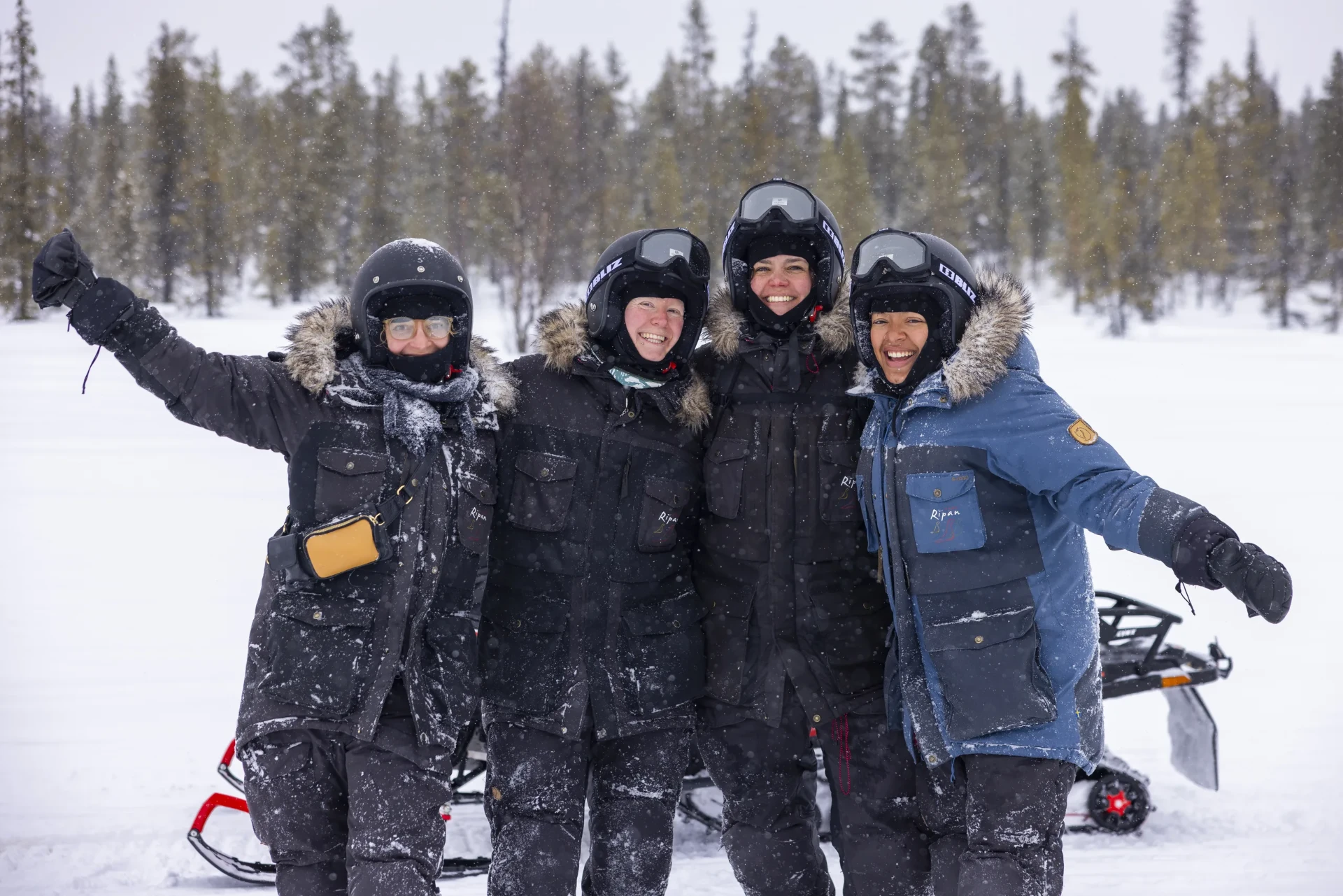
Standing on an open lake at night in January can mean minus twenty or colder, and standing still is much harsher than moving. You wear the full winter clothing set we provide over your own thermal layers, and there is a lavvu with an open fire, or a fire outdoors, to retreat to with a hot drink. Bring two pairs of thin gloves for camera work, and hand warmers if you feel the cold badly.
Yes, with one caveat: it is late and it involves standing around in the cold. Children who nap in the afternoon usually cope well and love it. There is no walking to speak of, and you can sit in the warm vehicle or by the fire whenever you want, so mobility is rarely a problem. Tell us the ages in your group and we will plan the night around them.
This experience is included in The Feel Good Week, our four-night Kiruna package, along with every transfer and the full winter clothing set. Planning details such as flights, packing and weather are on the practical information page.
Every experience in the Feel Good Week

The Arctic is waiting.
Four nights in Kiruna, arranged end to end. You only book your flights.
See dates & availability